
Bathroom Rumblings
Via the comments, and the pages of Gay Community News, more attempts to justify the odd and improper:
Ah, a glimmer of realism, one might think. Perhaps the fever is passing.
Or put another, less dramatic way, cross-dressing men will be excluded from ladies’ toilets.
And yet.
You see, not being allowed to violate the intimate boundaries of other people – specifically, women – in order to exult in a deception, a sexual fantasy – is deemed both oppressive and terribly unfair. Indeed, “cruel and demonising.”
We’re then told, in ways both emphatic and unconvincing, that restoring normal proprieties to toilets and changing rooms is “actually dangerous for cis people as well.”
If a law keeping weird, cross-dressing men out of ladies’ toilets and changing rooms doesn’t sound obviously dangerous to women – unlike those aforementioned weird, cross-dressing men – an attempt at persuasion is made. Or at least some crumbs are scraped into a pile:
As you might imagine, the word many is doing some heavy lifting, to a degree one might call deceptive. However, we’re steered towards a handful of examples, spread over a decade, in which actual women were mistaken for cross-dressing men and questioned on their use of female spaces:
A slightly absurd situation, granted. Though readers will note the phrase a man twice her size – and perhaps ponder how that phrase might inform objections to men intruding in women’s intimate spaces. Including rape shelters, where, as we’ve seen, events much like a nightmare can rapidly unfold.
Because it turns out that when forcing brutalised women to share a space with mentally ill men, the result is not, amazingly, one long, girly pillow-fight.
Oh, and we mustn’t forget Mr Morgane Oger, mentioned here, who spends his time campaigning to financially cripple women’s rape shelters, on grounds that said shelters don’t also cater to cross-dressing men, i.e., men much like himself. A preoccupation that possibly tells us quite a bit about the kind of man he is.
The author then performs a bold rhetorical manoeuvre:
Female readers – sorry, “so-called ‘biological women'” – are welcome to say whether they would feel safer in toilets and changing rooms with or without the presence of weird, cross-dressing men who feel entitled to violate normal boundaries. And whether the overlap of cross-dressing and unsavoury phenomena is a thing one might wish to bear in mind.
Unsurprisingly, the piece includes many questions of a somewhat disingenuous nature. Among which,
And,
Regarding the latter, it turns out that human beings are actually quite good at determining the sex of other people, especially of adults, and especially men. With studies suggesting an accuracy very close to 100%, even in restricted conditions – i.e., no visible hair, no make-up, no facial hair, ears hidden, no movement, etc.
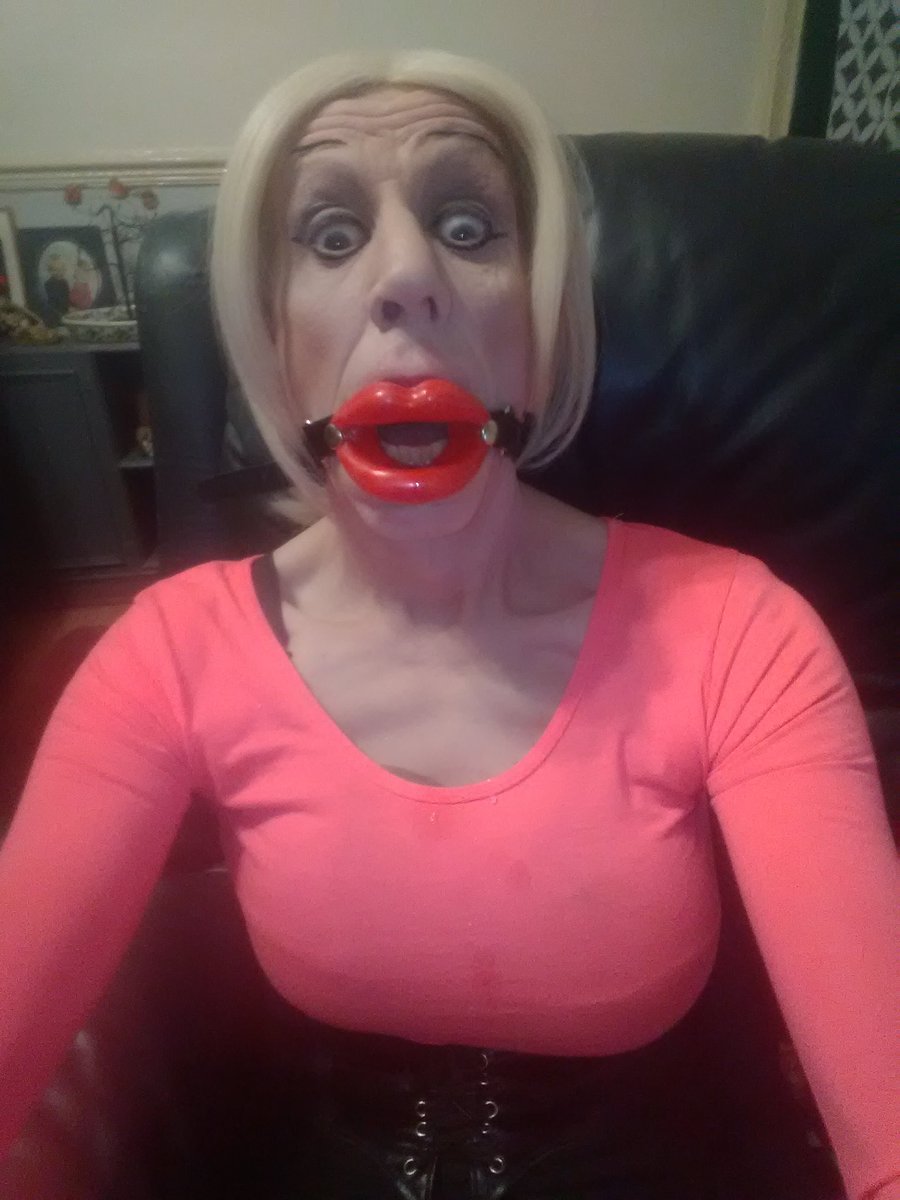
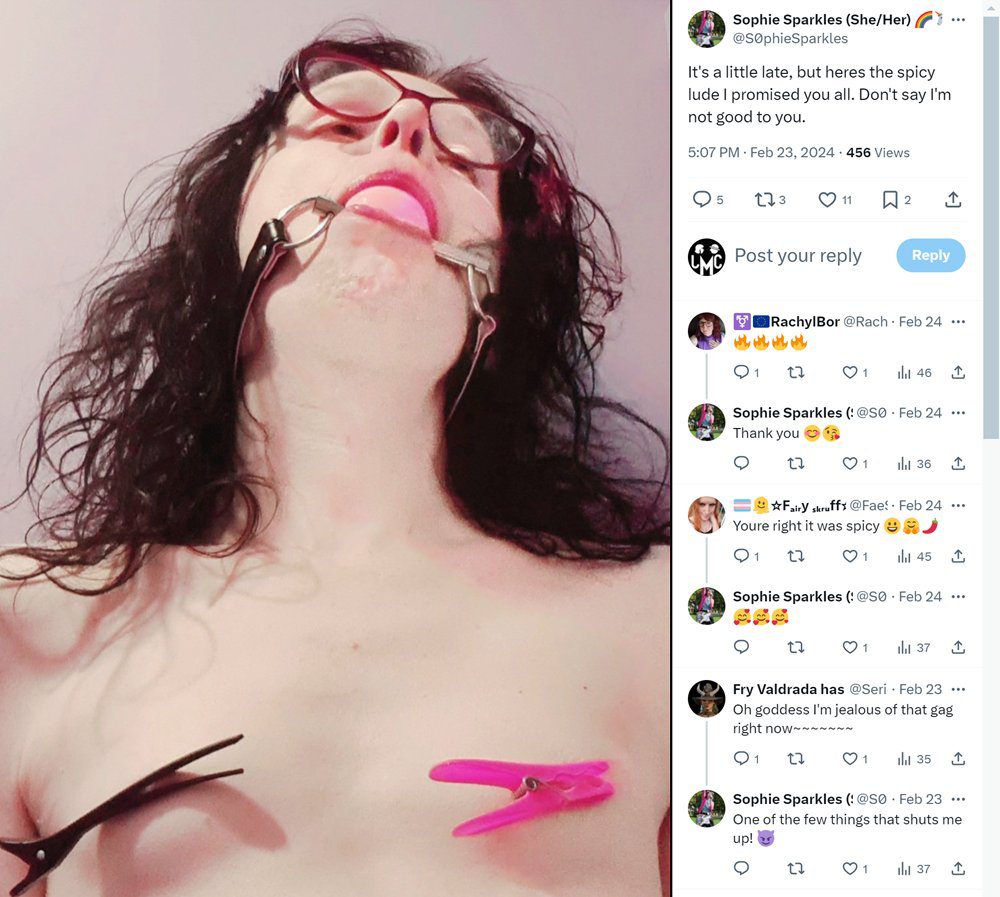
The author of the quoted piece, Mr Sophie Molly, aka Sophie Sparkles, aka Euan Weddell, is, you’ll be shocked to hear, one of those weird, cross-dressing men. The ones that women and girls should welcome into their toilets and changing rooms. His activities include boasting of demanding needless bra fittings from lingerie department shop assistants, and sharing photos of himself wearing only a ball gag and improvised nipple-clamps.
So, hey, nothing to worry about, ladies.
At which point, readers may wish to consider some of the factors pointedly not mentioned by Mr Molly. Among which, the fact that the incidents he refers to, in which actual women have been challenged on their use of female spaces, are not only extremely rare, but have only occurred since cross-dressing men – men much like Mr Sophie Molly – have started barging into women’s spaces, heightening sensitivities. Which one might think has some bearing on the case he’s trying to make.
As commenter Ollq puts it,
MtFs make the issue salient by publishing pictures of themselves territory marking in women’s bathrooms, crowing that they’re in every bathroom, probably in your bathroom, and there are more of them every day. The result of this awareness raising is that square jawed or broad shouldered women, who previously would have been taken to be women who happen look a bit masculine, are now more likely to be taken for MtFs.
The demanded solution, obviously, isn’t for MtFs to stay out of where they’re not wanted, but to legally protect the right of MtFs to go where they’re not wanted and to punish those who don’t want them there.
Indeed.
Should any readers be blissfully unfamiliar with the boastful, territory-marking nature common to such boundary violations, a compendium of intrusions can be found here. Though I should add that the linked video, while strongly recommended, is rather vivid and not for the faint of heart.
Update:
One of Mr Sophie Molly’s favoured slogans is “Trans led journalism that reports the truth behind the lies.” Which is almost funny, in a grim kind of way.
Setting aside Mr Sophie Molly’s implausible omissions, contrived framing and ludicrous hyperbole, we’re left with a claim that a law keeping mentally ill men and cross-dressing perverts out of spaces where women and girls get undressed is “actually dangerous” for women and girls and should therefore be abandoned.
Why, it’s almost as if men who lie continually – whose “identity” is premised on an attempt to deceive – and to coerce – are not entirely trustworthy.



I’ll get over it.
That’s one hell of a rabbit hole.
Yes, it’s a peep-hole into bedlam. But it’s the kind of unhappy context one has to bear in mind. Much as many trans activists – including, I would guess, Mr Sophie Molly – would rather you didn’t know.
Solution: single seater toilets. With a sign saying “Piss Here.” Anyone can use it.
Otherwise, we as women should be ready to point, laugh, and deploy mace if needed. Also, smile and shake you head, saying, “That doesn’t work anymore” when they call you a transphobe.
Unless, of course, he and his peers would like women to know about such things while submitting anyway. Conceivably, that might be the sweetest cherry.
It wouldn’t be at odds with the kinds of behaviour we’ve seen umpteen times.
See also.
Needless to say, further examples are available in the archives.
Have the bar snacks acquired a certain . . . pelagic . . . nature as of late?
As is often the case with rape, it’s about power, privilege, and that particular mixture of envy and spite rooted in inadequacy.
[ Opens @aelf dossier. Writes “suspected Vox subscriber”. ]
I do like the ping-pong ball sponges.
[ Orders case of them, unrefrigerated. ]
[ Defrosts two portions of home-made chili, checks fridge for sour cream dip. ]
Yet another single-sex space invaded?
I can guarantee you that most of us can identify a man just from his feet or hands. I can think of only a couple of times where a person, chubby, wearing ambiguous baggy clothing, ambiguous haircut, had me wondering.
[ Grates cheese. ]
“Bathroom Rumblings”
Didn’t we used to call those “farts”?
This is very much a case of “can’t they both lose”. Anyone who thinks women’s rape shelters are primarily in the business of, you know, providing shelter to women who have been raped has not been paying attention. They’re political advocacy offices dedicated to pushing an extreme agenda. Part of the reason Mr. Oger’s suit is ongoing is that many women’s rape shelters do provide residence to autogynephiliacs without regard to the traumatized women already residing there, and have ejected women who objected to the practice.
And then there’s the fact that the owner and operator of the only men’s rape and domestic abuse shelter in Canada was hounded to his death by the women’s rape shelter network, despite his shelter operating entirely on private donations.
Figure. It. Out. Yourself.
Case in point: the “rApE iS aBoUt pOwEr aNd PrIvIlEge” shibboleth is right out of the radical Marxist feminist manifesto. Via la revolucion, comrade.
“Vivid”! Did you mean emetic?
As I’ve said before, it is rather graphic – but not unfairly. I tend to think that anyone who insists on affirming men who claim to be women, especially men who feel entitled to barge into women’s bathrooms and changing rooms, should first watch that video. In particular the three or four minutes I’ve linked.
It does offer some important, um, context.
But hey. Pride, baby.
Any “report” from the ACLU should be taken with a grain of salt, and by grain I mean an entire 5 Year Plan output of a Siberian mine.
Not exactly seeing the downside here.
I think he meant the negative impacts cannot be stated, but if he feels that way it is a short hop to hie himself across the channel where,
I am guessing that means the right to use whatever loo they have a hankering to use so they can be “seen”, though stating the obvious, “everyone” deserving to be safe probably does not apply to non-LSMFTBBQ¶.
Nature is healing.
People were willing to accommodate others they felt had actual needs, but it’s become transparently obvious that that’s an extremely small (approaching nonexistent) percentage of the people demanding special treatment.
The overwhelming majority are simply narcissists who expect others to give them preferential treatment, and people simply aren’t interested.
And, like most narcissists, when they don’t get their way, they lash out at the rest of the world and throw tantrums.
It’s ‘viva‘.
Projected or actual?
Not entirely unrelated.
Only a revanchist counterrevolutionary would suggest there is a difference. ты в ГУЛАГ, друг.
The chili was awesome, by the way.
Thanks for asking.
The chili was awesome, by the way.
I tried a plain cheese Aldi pizza that was surprisingly good – a blank slate, I could doctor it with some arugula, garlic, and extra cheese.
Fancy I am . . .
Hell, yes.
Not just yes, but for pity’s sake, a functional society does “exclusion” all the time for “safety” reasons. Whether it is excluding minors from adult activities and spaces or putting convicted criminals in prison, right down to locking one’s front door at night — exclusion is not a dirty word.
[ Shovels fistful of Forest Feast Berries & Cherries into face, chewing ensues. ]
[ Shovels fistful of Forest Feast Berries & Cherries into face, chewing ensues. ]
such shameless mastication – and in public, too!
well, I never!
“everyone deserves to be safe” means “I demand to get what I want”
There. Fixed it.
Wanye’s Twitter account is still hidden. 🙁
Do you remember the good old days, when pronouns were something you studied for foreign languages, and otherwise were used to make communicating easier? So you wouldn’t always have to repeat the name, Rufus Xavier Sasparilla?
https://youtu.be/koZFca8AkT0?si=vcRc79tjuJ3wiQEz
the progressive New York subway experience.
So neo-pronouns save us the bother of repeating Entitled Nasty Bedlamite ad infinitum?
Anti-racism in practice?
That thing that never happens has happened again.
The whole purpose of “trans rights” and “pronoun respect” is to enable pervs to bully and molest innocents.
Try harder.
Openly.
Evensong.
[ Post updated. ]
Still chuckling at the awareness raising bit.
I’ve previously mentioned how people often assume that the more one comes to know about a phenomenon, the more indulgent and sympathetic one will be, as if this were some inevitable default. When in fact the opposite can often be true. Research may not result in warm feelings and an urge to affirm. Let alone to surrender intimate territory.
How the hell did we get here?
Thanks in large part to vain and unrealistic people, most obviously progressive women, who are fixated by in-group status and being seen to have fashionable opinions, and who think that niceness, as they conceive it, is the highest possible moral state? As if doing the right thing could never entail saying no?
Just spit-balling, of course.
a functional society does “exclusion” all the time for “safety” reasons
Functional groups do exclusion all the time because you can’t have a meaningful group without exclusion. The safety of the members is one of the reasons, also trust, intimacy, continuity, cohesion, group identity, ability to identify common interests and act collectively.
Those who tell you exclusion is immoral either don’t want you to have a group identity, which is the reason for the legal restrictions on groups of men excluding women and groups of whites excluding nonwhites; or in the case of trans, it’s an attempt to parasite on the intimacy and vulnerability of female ingroups.
If a group is only allowed to exclude on the basis of safety, they just get dragged the kind of whataboutery and content-of-the-character arguments we see in the GCN article. It should be sufficient to say you’re not us and never will be, we don’t have to justify ourselves to you, you know this already and are being disrespectful of our boundaries. Everyone grants those rights in practice to the groups they actually respect.
It’s not just the ladies, of course. We’ve seen plenty of progressive men perform the same mental contortions and willingly become absurd in order to maintain their own in-group status. Their pretence of piety.
Pronouns were invented because of Johann Gambolputty de von Ausfern-schplenden-schiltter-crasscrenbon-fried-digger-dingle-dangle-dongle-dungle-burstein-von-knacker-thrasher-apple-banger-horowitz-ticolensic-grander-knotty-spelltinkle-grandlich-grumblemeyer-spelterwasser-kurstlich-himbleeisen-bahnwagen-gutenabend-bitte-ein-nürnburger-bratwustle-gerspurten-mit-zweimache-luber-hundsfut-gumeraber-shönendanker-kalbsfleisch-mittler-aucher von Hautkopft. . . of Ulm
[ Recalls being lectured by libertarians who would “explain” that there is nothing wrong with males in female bathrooms and locker rooms, and that we Americans are just “weirdly afraid of” such things. ]
the progressive New York subway experience.
I have seen another video put out by this guy, one where he demanded a White guy standing in line in a deli buy him a sandwich, else be accused of racism. That guy just smiled and said “No.” As these women should have – I am guessing they are transplants to NYC or tourists. I would like to think that a woman from what are termed “the outer boroughs” (the Bronx, Queens, Brooklyn, and Staten Island) would have responded with a decisive “Fuck you.”
Though, I don’t know – Brooklyn’s been getting soft . . .
The milk of human
kindnessmadness.