
Those Happy Fat People
Says the website of the University Heath Service:
Weight stigma in athletics. I’d better write that one down. The site also stresses the importance of “body positivity,” which is,
Well, losing some of that excess weight would probably help on that front. Less crippling self-consciousness. Less sweating and wheezing, too. We also learn that “weight stigma” is perpetuated by language. Not, say, by being massively fat and the problems that so often follow from that.
At which point, sharp-eyed readers will notice that the direction of all this effort is away from the actual problem.
Well, again, obesity will do that. Best, then, to keep oneself in some reasonable proportion. Rather than faffing about with five-dollar bits of cardboard that make it clear just how neurotic you’ve become. As a result of being fat.
Update, via the comments:
Svh quotes this from the university’s website:
And adds,
Well, quite. And it has to be said, if you’re unwell and are avoiding going to the doctor because you can’t bear the prospect of being asked how much you weigh, this doesn’t sound like “body positivity.” Indeed, the very notion of “body positivity” will likely be of interest only to people who very much don’t feel “positive” about their bodies.
Say, on account of being fat.
And then there’s this, from the College Fix article:
Because – and I say this will love – you’re too fat for the chairs.
So, at risk of sounding insensitive, a choice comes to mind. You can either try to reorganise your every interaction with the universe – every encounter with chairs, mirrors, small spaces, stairs, and so forth – and drag everyone else into some never-ending drama in an attempt to ease your hangups – or you can, you know, dial back on the carbs and sugar and take a brisk walk.
I mean, the thing you can hope to control is not other people.
Update 2:
This seems apposite. Luana Maroja, a professor of biology at Williams College, ventures into the belly of “fat studies” and reports on what she finds:
Here I describe two college-sponsored events dealing with “fat studies”—one in late 2024 and another in April 2026—which I attended out of simple curiosity about this academic discipline. Here is an account of the claims made at these events taken from my notes.
There follows much to chew on. Including claims by supposed educators that “a healthy diet is [whatever] you like to eat,” that fat people are oppressed by dieting and by other people not wishing to be fat, and that such preferences are a form of “white supremacy.” Oh, and the desire not to be fat oneself – dubbed “fat fascism” – is all about racism and the “subjugation” of Palestinians.
Also, chairs are discriminatory and a cause of health problems. Unlike being fat.
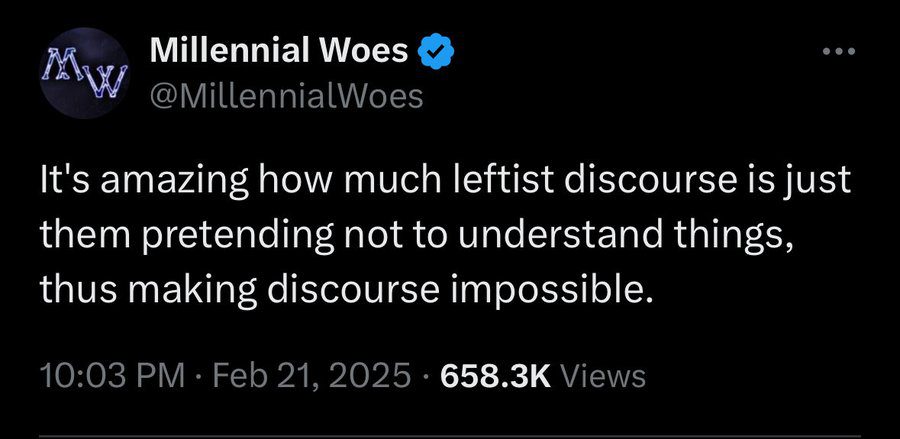
Among the educators in question, there was, inevitably, a lot of pretending not to understand things.
Update 3:
Commenter Chow Bag quotes this,
And adds,
The participants do seem to be devoting an awful lot of effort to their word salad and contrivance – and blatant lies – all geared towards avoidance and displacement. Again, the direction of the rhetoric is away from the actual problem. They seem willing to perform almost any mental contortion in order to avoid acknowledging the obvious about themselves and their behaviour.
And so, for instance, we’re told that very fat cancer patients shouldn’t be advised to lose weight, as this is “discrimination,” an outrageous emotional injury, even though their obesity has numerous, quite serious, well-documented consequences in terms of treatment options, complications, likelihood of recovery, long-term survival, etc.
It’s not politics. It’s psychodrama. Albeit in bad political drag.
It’s tempting to invert the scenario and to imagine some gathering of the Anorexics Liberation Front. A roomful of alarmingly cadaverous young women complaining about the alienating vastness of chairs, and about how anyone concerned by the attendees’ self-harming behaviour – say, parents, spouses or children – is being oppressive and racist.
Consider this an open thread. Share ye links and bicker.
Pies and cakes available on request.




Remember Ezra Klein? Wouldn’t it be fun if his career could be destroyed?
Enthusiasm for the Constitution varies widely between demographic groups.
Posters do also show negative examples, so I guess he still is a poster boy.
Just call him Oedipus.
He was not, in fact, a woman.
Forty years ago, Billy Crystal’s SNL parody of Fernando Lamas, “It is better to look good than to feel good, and I look marvelous!” was universally understood to be mocking shallow delusion.
Now it is public policy.
I’d rather marry a duck-billed platypus.
Well there’s one fucked up scene. I had to watch it a couple times because I couldn’t believe there were authorities on the scene, that that red suv with flashing lights was a fire chief or whatever. At first I was a bit shocked at first that so many people drove past doing nothing but even the fire rescue guys…in TEXAS… are too afraid to intervene. What a fucking disgraceful society.
“I’m sorry for being black”
When black is a euphemism for “sociopathic asshole”.
Texas has personal injury lawyers too.
And Texans support them. But let’s keep supporting the culture of fearing the lawyers over the criminal scum. I see people here cheering for helicopters and lynchings and woodchippers and such, but a cop gets persecuted for use of a non-lethal beanbag and it’s “IT’S A LETHAL WEAPON BECAUSE THE LAWYERS SAY SO”. And that’s when the lawyers didn’t say so.
“You never get angry? Never?…People who do not engage in conflict are always resentful.”
Thank God someone who isn’t me said it.
The BBC: “Complex choices” are why it failed to cover the rape gangs.
Well, “complex choices” are why I post memes about helicopters.
Complex choices are why I support cops who use non-lethal weapons, like bean bags, because they’re being persecuted for using lethal force because lawyers say it is so. Complex choices are why I don’t go crying about the horrible powers of the state that then, by golly, could be used against us. Because it’s not about logic and reason. It’s a far more complex choice.
TDS. There is a cure.
Granted, this is People Magazine but they are simply regurgitating for a broader audience what NYT “journalists” have published. You cannot hate the media enough.
So here’s one for all yuze DuckDuckGo fans…trying to recall some of the lyrics to the song Camelot, so I axed the Duck….
Well, of course yuze knows the rest so I don’t needs ta be borin’ ya…
Apropos to this thread.