
Just Happens, You See
Another glimpse into the mind of the scrupulously progressive:

Because, says Mr Gold, our pronoun-stipulating essayist, a sense of connection with one’s home, one’s territory, one’s ancestry and how one came to be, is “utterly arbitrary.” A thing of no importance, unworthy of consideration. Says he, or he/him, “The only sensible form of government is one-world government.”

You see, becoming even less important, even smaller in relation to the steering of the ship, one of billions instead of millions, is a good thing, it turns out. And that irrelevance is sensible, a thing to which the rest of us should apparently aspire. Star Trek, I fear, has much to answer for.
Mr Gold is happy to be described as a “rootless cosmopolitan.” Lofty and unaffiliated, and thus exempt from customary expectations. Because status, baby. One simply must be seen having those designer opinions. Whatever the practical consequences of those opinions might prove to be.

And while pointedly disdaining as foolish and low-status any sense of connection with, or affection for, the country in which he just happens to live, Mr Gold is simultaneously an emphatic supporter of Palestine, regarding which very different assumptions would seem to apply.

The world of things just happening, entirely by chance and for no reason whatsoever – in the progressive mind, at least – has been poked at here before.
From which:
Because apparently all things are possible in progressive metaphysics.
Update, via the comments:
Geoff asks, not unfairly,
Well, Mr Gold’s obliviousness does seem rather contrived, a modish affectation. And despite his ostentatious sneering at pretty much anything patriotism adjacent, I remain unconvinced that a country inhabited only by people who think as he does would long survive.
Readers may wish to ponder how Mr Gold, and doubtless many of his peers, can denounce Mr Trump as some kind of quasi-fascistic, totalitarian nightmare, an end to democracy, while simultaneously enthusing about a one-world government, as if the prospect had no implications for democracy.
Also, it’s unclear where the boundaries of this disdained patriotism are. Does it include the feeling that one’s country is more than a hotel, a holiday resort, or an economic zone? Does it include a background sense of attachment, of lineage and continuity, of history? Does it include the sense – say, while driving through the countryside – that “I like this place, I know this place”?
I ask because, while I’m not prone to flag-waving or wearing patriotic hats, I do understand a sense of belonging, of attachment, of home.
And I think I understand the kinds of people who disdain such things.
Though I can’t say I like them.




Twenty years or so ago, I had to restrain my father and take him outside, away from the Thanksgiving dinner table. Because my brother-in-law, an Indian immigrant who had grown up polo-pony wealthy in Hong Kong and Singapore (the best place in the world according to him) and at Ivy League Cornell, had claimed that the only reason people do, or should, come to the US was economic.
My father, a normally very calm person, but also a former US Marine officer (WW2 & Korea) did not take this well and almost went over the table at him. I’m sure my BIL’s typical smug delivery did not help.
Herd immunity?
Which herd?
[ Blows square of kitchen towel, now rather more crumpled, towards Aelf. ]
Went through the responses to the original post, which in many ways are a relief – except the open antisemitism. I seem to remember a lot of “being anti Zionist isn’t antisemitic,” but the pretense seems to be cast away now. Or is this just me?
I never fail to be nonplussed by otherwise sensible people who appear to have gotten their entire model of how societies and economics ought to work from Star Trek episodes and Pratchett novels.
These are children’s entertainments, produced by people who were intentionally propagandizing to children. If I were to end any discussion on social ethics with the phrase “…and knowing is half the battle – G.Iiiiiii. JOOOOOE!” I would not be taken seriously, and rightly so.
If I told you that despite making up only 13% of the population, Lokai’s people were responsible for 53% of all the violent crime, does that change your view of the narrative?
Sami Gold is very typical of Jews who are very worried that they might be viewed as Not One of Us, Dear. Because they have to pretend not to understand the Jewish love of Israel, they find it easiest to simulate a complete lack of any loyalty to any country (or state, city, town, village, etc) at all, and to express a sort of pitying condescension to those of us who aren’t so detached. (I just spent half an hour writing an Unherd comment trying to explain, as a Jew, the general Jewish loyalty to Israel to someone who is baffled by it. You won’t see the comment, however, which has been classified as ‘spam’ for some reason and is in administration.)
I can’t speak to the Pratchett point as I’ve never read his books. But yes, we’ve discussed the implausible hand-wringing and fantasy economics of Star Trek several times over the years, most obviously in its 80s-onwards iterations. The “pernicious ideal,” as I believe Dicentra put it.
Again, the fantasy socialism of TNG onwards implies many things that are never shown and never explained in anything but the most glib and throwaway manner. For decades, the writers and producers somehow avoided any thought-out depiction of how it might actually work, despite it being referred to in-universe, many times, as the foundation of pretty much everything else.
You can, if tempted, buy technical manuals and elaborate schematics of shield grids and plasma conduits, as if these things were real, and you can nosey around every inch of each starship, including the toilets, in games and 3D virtual tours. But the fantasy economics that supposedly underpins the world of Star Trek remains a hell of a lot sketchier than transporters or quantum slipstream drive.
The Expanse TV series made some effort to sketch out a plausible economic footing for its space-faring drama – and was, unsurprisingly, much less utopian.
I do sometimes wonder how much of that is due to their incomes coming largely from royalties and residuals – money that just shows up, every month, because of a fluke popular project worked on years ago with no more exceptional effort than any other, that’s sufficient to cover all the necessities. Leaving the writer/producer to write/produce for the fun of it, as a vocation, rather than because they can’t pay the heating bill if they don’t sell a manuscript this month.
It’s probably also worth noting that all of the technical detail is just as flimsy gibberish as the economics. It’s just that people mistake detail for plausibility.
You mean you weren’t impressed by “Heisenberg Compensators”? And laughed at exploding instrumentation boards? <grin>
Yes. Though I did appreciate the occasional attempts to give structure to the drama by suggesting limitations, distances, etc. How long it would take to get from A to B, how much damage would be sustained if such-and-such happened. Things of that kind. Whereas in, say, Doctor Who it’s just magic-box-does-whatever-the-writers-want-this-week.
[ Feeble cough, wheezing. ]
Lace some hot tea with whisky.
Don’t like, or have, whisky. I will be having a measure of Night Nurse shortly.
So there’s that to look forward to.
“This is Charlie Company—send reinforcements!”
“Enemy planes—hit the dirt!”
To some degree, it’s almost all children’s entertainment. Looking at most fiction with a half century of real world life, the degree one has to suspend one’s sense of reality is stunning once you realize it. I still have occasion of realizing some minor myth, good or bad, that I had bought into when a youth has blinded me to understanding something about another country or this country’s history or other people in general.
Before the pandemic, on the very, very few occasions when we went to movies, the trailers for the coming attractions were increasingly so ridiculous and preposterous, and mostly dark, end-o-times disaster flicks that it was clear to me that the general public was being programmed for something. I remember telling my wife that I just wish the bloody world would really end so one way or another we wouldn’t have to see another one. Some time after the pandemic (well after for us, some are still in it) we went to a movie and when the coming attractions were showing, only then did it hit me what had been happening.
The writers are generally competent. The reason so many of the TOS writers abandoned TNG in the first season was that Roddenberry had created a setting with no conflict. No conflict means no drama, so how were they going to write anything? So you get a lot of monster-of-the-week episodes, or colonialism episodes, or (as they settled into in later seasons) gadget blow up, make problem.
Until the SFX budget got out of hand, so it devolved into “female crewmember[1] blow up, make problem”
[1] Well, sometimes it was Lwaxana.
Sue: well said. It may also be something somewhat related:
Historically, Jews have been very patriotic towards the governments under which they lived, even when said governments were, shall we say, less than reciprocal to them. (As an example: Spanish Jews supported the Reconquista, only to then be kicked out of the country.) It goes all the way back to Jeremiah telling the Jews exiled to Babylonia to “seek the welfare of the city to which I have exiled you, and pray for its welfare,” and in fact to this day, in many synagogues, they recite a special prayer on the Sabbath for the head of state (mentioning the president here, Charles III and his family in the Commonwealth, etc.). As another example, in places where Jews knew that the army would give them a fair shake (so not czarist Russia, but for example in Germany and Austro-Hungary in World War I, the Western Allies in World War II, etc.), Jews have volunteered for the armed forces in large numbers, sometimes more than their proportion in the general population.
So, unfortunately, deracinated Jews such as this Sami fellow see all that as an embarrassing atavism, and (as with most of the rest of Jewish ethics and ideology) reject it.
There’s a film crit theory that says that horror movies reflect the subconscious anxieties of the general population (with a bit of a lag, given that it takes a couple of years to get a movie into the theaters). It’s pretty well supported, right back to Bronze Age Greek drama (during the Hellenistic Age, getting kidnapped by pirates while traveling was a common trope in Greek drama because, well, it was happening a lot).
I think these days it might be more accurate to say that movies, horror or otherwise, reflect the anxieties of the people who make them.
Gin? With extra tonic in case your cold is actually malaria.
I have no idea what he’s yelling. I don’t speak Spanish, nor do I speak loony.
Speculation: “My diaper is full and I want my mommy!”
That is some brummagem yankee mix, the proper formula is bourbon, honey, lemon, and tea.
Add tapioca and it’s bubba tea.
It’s medicine, not enjoying it is a feature, not a bug
The pretense was always paper-thin. Natan Sharansky wrote about it 23 years ago and it is more than relevant today.
Brandy works too.
Hot buttered rum could be an acceptable substitute.
Is this the season for exploding fireworks factories?
It works.
And I don’t much care for lemon and honey in combination.
Has it been happening frequently? I’ve not been paying much attention to the wider world of late.
I’ve accidentally run across three in the last 6 weeks or so: Malta, China, and India.
This should stir the pot.
Is it time for fiery but mostly peaceful protests?
..
That’s what I used to think as well. But once SHTF in March 2020, there was a good number of people whom I otherwise considered intelligent and somewhat self-aware who were behaving like people in those movies. Many otherwise sober minds made references to how this or that disaster movie went down. I had one friend tell me that I was behaving “just like the sheep in those movies” who don’t listen to the scientists trying to warn them, that I was like the mayor of Amity Island wanting to keep the beaches open, etc. I’m not talking about surfer dude types, I mean people like managers and technical leads, etc. Otherwise intelligent people whom one…well I anyway…would expect to be thinking for themselves.
I understood it at first, but as the weeks dragged on I had a hard time taking anyone seriously. A few have sobered up but…brainwashing is the only explanation I can find for how broad that idiocy spread. Mass psychosis perhaps, but the ground had been prepared by those movies, along with whatever trash fiction those movies spring from. Maybe a coincidence…maybe.
Should. But since it’s Farage saying it, how many people behind the irony curtain are likely to see it? Don’t they just ignore him over there? I’m sure his fans/followers will likely see it. What I’m curious about is where are the other prominent right-of-center pols and personalities calling for this? Maybe I’m just not seeing it over here but has anyone in the Tory or Lib-Dem parties said anything? I doubt anyone in Labor would have the guts but…meh, nie mój cyrk, nie moje małpy.
Restraining a Marine seems like a…challenge.
Sounds like an arrogant bigot. Maybe he needed to be popped in the mouth.
On the one hand, I’ve seen this show up with other tropes. There’s a massive number of fictional wars that turn out to only be because an arms dealer started the war so he could sell both sides weapons. There’s never any actual centuries of historical animosity; as soon as the arms dealer is gone everyone gets along perfectly. Gotta blame Capitalism, no matter how many real wars get along without modern weapons or how many real wars seem to involve large amounts of weapons from non-capitalist sources.
On the other hand, Klaus Schwab appears to tick every check box for a real world Bond supervillain, and yet the same people that seem programmed in other cases don’t respond.
I have, indeed, noticed that people don’t read much any more, what they do read is fiction, and what they consume in lieu of reading is simplistic film and TV shows with a ham-fisted The Message. The latter, in particular are even more dumbed down than usual.
It’s not a new phenomenon; boomers were lamenting 15-20 years ago that millennials were getting their news from John Stewart, Stephen Colbert and John Oliver.
There was a time when these asshats had at least a little self-awareness. There was an interview with Jon Stewart where he was taking CNN to task for their bias during the Gulf War (yes, really) and when they tried to accuse him of not being perfectly objective and accurate either, his response was “The lead-in to my show is puppets making crank phone calls. You’re CNN.”
Frankly I feel like CNN could have boosted their flagging ratings by adding some puppets. It couldn’t have hurt.
I have a modicum of respect for John Stewart partly because he apparently refused to do the stupid Aristocrats joke, partly because he was one of the first well known, mainstream-ish people to openly mock the absolutely absurd pangolin bat theory of covid’s origins, and partly because I’m just guessing/going on instinct that I know what the word modicum means…though I’m pretty sure…just too lazy to check…
Yes. That. Like…helloooooooooo? And I’m a guy who is quite certain, very certain that Lee Harvey Oswald acted alone.
Thing that never happens, etc., and so forth.
Bodycam footage of note.
And of intense interest in this thread.
Apparently, it’s Gypsy, Roma, and Traveller History Month.
We must all gush and pretend again.
Coming soon: Trespasser, Thief, and Antisocial Nuisance History Month.
Too many people fail to remember that (1) Pratchett writes satires, which implies distortions and selective focus, and (2) Pratchett doesn’t actually say much about how economies work. As for Star Trek and economics, the less said the better.
The Kennedy assassination was one of my obsessions, and for awhile I believed the conspiracy theory. And there is one, you know: Between the CIA and the FBI to cover up how badly they fucked up.
What also didn’t help was, over the years, seeing numerous cases for a conspiracy. The CIA did it. The FBI did it. LBJ ordered it. A retired police detective met the hit man who described what happened, and the author helpfully included copies of his award citations, so he must be Telling the Truth. Finally, to cap the absurdity, that book in which the Secret Service agent riding in the back of the limo accidentally shot JFK.
“Case Closed” did a good job stating the case for Oswald doing it alone. If you don’t have time to read, this documentary did a deep dive into what went on in the Book Depository that day. And in the first 10 minutes, when you realized what it took to get Oswald his job there, you realize that a conspiracy to put him there beggars belief.
(I might have mentioned this before here; sorry, but even if you’re only interested in true crime, this is a beautifully directed and narrated dox, as is his others on Jack the Ripper and the Russian hikers mystery.)
Same. I wrote an AP history essay on the similarities between JFK and Lincoln assassinations, got an OK grade on it, mostly because I skipped over the well known, popular stuff and tried to find other similarities. Teach was disappointed that I left out the well known stuff. Then I find out years..decades later that the well known, popular similarities were either long stretches or mostly BS.
This. As the web/net was becoming a thing it was much easier to find out all the conflicting information. What bothered me even before that was how many different theories there were yet none were ever kicked to the curb as implausible. In fact, as the years went on, even more theories, mostly unrelated to each other were popping up.
There are two things that I do feel are remotely possible. I do believe LHO acted alone. These other gunmen theories are BS. But I do believe it is possible that someone in the CIA or FBI put a bug in LHO’s ear or unknowingly to him, steered him in the right direction with hints about opportunities, etc. Then either the many conspiracy theories popped up organically and the CIA/FBI elements took advantage of the opportunity or they perpetuated the many theories themselves as a bunch of red herrings. And even if neither of those things are true, I do believe that deep state elements are riding these CT’s as red herrings for what has been more clearly exposed, i.e. Russian collusion, etc.
Many years ago, a Canadian engineering firm pioneered the use of VR/3D modelling in forensic engineering. Useful for determining what happened before The Thing Fell Down, as well as what would have been visible from any given vantage point.
To advertise their expertise, they put out a video tackling…the Kennedy assassination. Modeled the book depository and Dealey Plaza, got a decent but not professional shooter to sight and fire rapidly at targets the same distance, etc. and then showed the whole assassination from LHO’s POV.
Conclusion? The shots were entirely feasible at that distance and angle in the time Oswald had available.
Going Postal is a book-length argument for public control of the postal system – remember, at the end of it they’re so effective they bankrupt the privately-owned klacks and end up taking them over from the original operators and lowering the prices.
Making Money is an explicit explanation of, and argument for, the fiat currency system.
Men at Arms describes an economic theory now so well-known it has its own Wikipedia page.
Pratchett knew exactly what he was doing – pushing bog-standard British soft-socialism on nerdy teenagers who ate it up like a spoon because nerdy teenagers are insecure and love the smug Britishness of it all. We’re just ever so smart, aren’t we, so much smarter than Mom and Dad and those icky Republicans. After all, we think the same way as this very clever and witty British person does, which must mean that we are also clever and witty.
No one would bat an eyelash at the notion that Heinlein had a clear pedogogical agenda when he wrote Starship Troopers. Point out that Pratchett is just as hamfisted and everyone loses their minds.
Only because the klacks system was being deliberately run into the ground. Prior to its takeover by those pirates, it was profitable.
And if I recall correctly, after the downfall of the pirates the city returns it to its original owners.
The Feral Historian in his recent video had the line “slaves say yes, free people’s ask why”.
https://youtu.be/IQNHy1_VJFI?si=NLk9wh3_qm97d20X
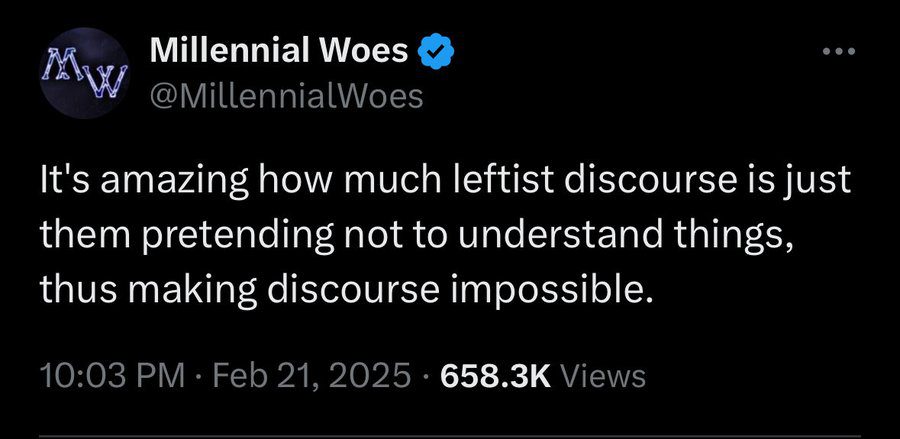
I’ve been thinking on this of late because it’s definitely true, it has deeper religious implications than I think we realize, and yet… there seems to be a point it’s wrong. Leftists are helping me to grasp the fine distinction in asking why – those who ask in order to understand, and those who ask to obfuscate and remain ignorant.
Which then calls to mind a line from Trek: DS9
“If I have to explain it to you, you’ll never understand.”